
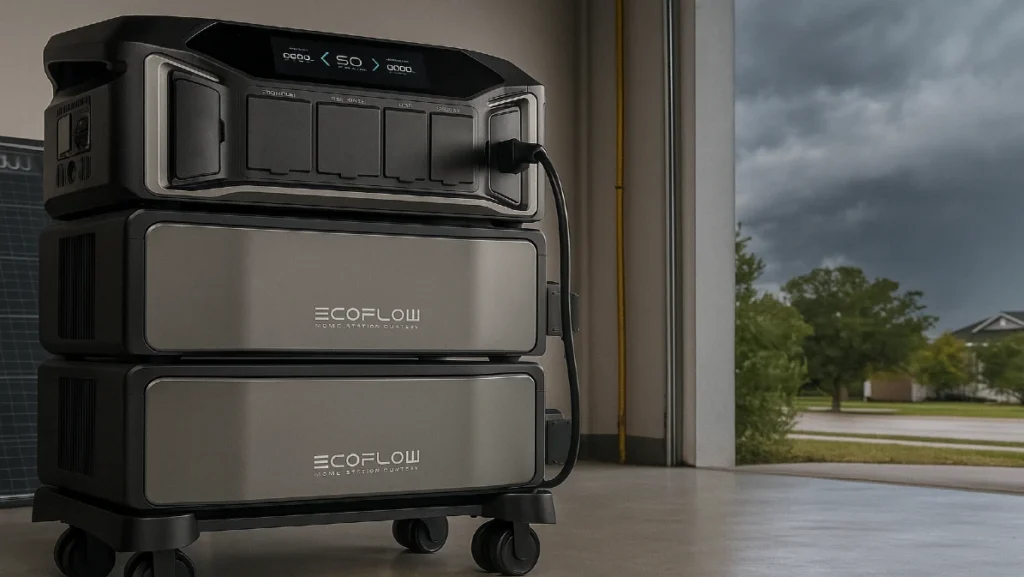
Planning Backup Power with the EcoFlow DELTA Pro Ultra
When the power goes out during a storm, life changes fast. The lights click off, the fridge stops humming, and the house falls uncomfortably quiet. If you’ve been through hurricanes like Ian, Helene, or Milton, you know how unsettling that moment can be. You’re suddenly wondering how long your food will last, how to keep medical devices running, and whether you’ll be sitting in the dark for hours or days.
That’s where the EcoFlow Delta Pro Ultra comes in. This isn’t just another portable power station you tuck in a corner for camping trips. It’s a whole home battery backup solution that can keep your essentials running through a blackout or even serve as the foundation for an off-grid setup. In this guide, we’ll go deep into what it can really power, how fast it recharges, and what add-ons are worth buying to turn it into a true home energy system.
If you’re looking for hard numbers, you’ll find them here realistic runtime charts, solar charging times, and clear comparisons to other big names like Tesla Powerwall and Bluetti. If you’re looking for real-world advice from someone who’s lived through extended outages, you’ll find that too. By the end, you’ll know whether the Delta Pro Ultra fits your storm plan and exactly how to set it up so you aren’t scrambling when the next storm warning hits.
What Is the EcoFlow Delta Pro Ultra?
The EcoFlow DELTA Pro Ultra is a modular lithium iron phosphate battery system for home backup. The basic configuration has one inverter and one 6,144 Wh battery. The bundle discussed here adds a second battery for about 12.3 kWh of nominal storage.
EcoFlow specifies up to 7,200 W total continuous AC output from one U.S. inverter, which supports 120 V and 240 V during discharge. Each outlet has its own limit. Ask a qualified electrician to check circuit requirements, starting loads and the installation if you plan to connect the system to home wiring.
For storm preppers and anyone living in hurricane-prone regions, this flexibility matters. You can start with the base unit and add components as your needs grow extra batteries for longer runtimes, solar panels for off-grid recharging, and the EcoFlow Smart Home Panel 2 for automatic switchover when the grid fails. It’s scalable power that grows with your plan, not a one-size-fits-all box you’ll outgrow after the first major storm.
In short, the EcoFlow Delta Pro Ultra isn’t just a backup battery. It’s an investment in security, comfort, and independence. And because it uses advanced lithium iron phosphate chemistry, it’s built to last for thousands of charge cycles meaning you’re not just buying a storm solution for this year, you’re building resilience for the long run.
See the EcoFlow DELTA Pro Ultra bundle with two batteries
Why Homeowners Are Switching to Battery Backup
For decades, gas generators were the go-to solution when the lights went out. They were loud, they produced fumes, and you had to keep cans of fuel in the garage, but they worked. Over the last few years, something has shifted. More families are turning to whole home battery backup systems like the EcoFlow Delta Pro Ultra, and once you understand why, it’s hard to look at gas generators the same way again.
Part of the reason is practicality. Storing gasoline is messy and dangerous. During major storms, finding more fuel can be nearly impossible. Even when you have it, running a generator means dealing with constant noise and checking every few hours to make sure nothing has run dry. For anyone who has had to refill a generator in the middle of the night during hurricane rain, the idea of a silent, indoor-safe battery is an easy sell.
Cost is another factor. The up-front price of a battery system is higher, but the long-term math looks different when you factor in fuel, maintenance, and wear and tear. A lithium iron phosphate battery like the one in the Delta Pro Ultra is rated for thousands of cycles. That means it can be charged and used for years without the same upkeep headaches you get from a gas engine that sits most of the year and only runs during an emergency.
There’s also reliability. Gas generators can clog, stall, or simply fail to start when you need them most. A whole home battery backup system is always ready. You plug it in, keep it topped off, and when the grid goes down, it starts supplying power instantly. No yanking on a starter cord, no waiting for it to “warm up,” and no wondering if this will be the time the generator finally gives out.
For homeowners who have lived through more than one major storm, the move to battery backup feels less like a trend and more like common sense. It’s quieter, cleaner, and ready when you need it most. And for families looking to add solar panels to their homes, a battery like the Delta Pro Ultra unlocks the ability to store that energy and use it when the grid goes down.
What Can the EcoFlow Delta Pro Ultra Actually Power?
One of the biggest questions homeowners have about the EcoFlow Delta Pro Ultra is simple: what will it really run, and for how long? Marketing claims are one thing, but when the power goes out you need real numbers. Knowing how many hours your refrigerator will stay cold or how long a CPAP machine will operate overnight is the difference between guessing and being prepared.
One battery stores 6,144 Wh on the nameplate. A second battery adds another 6,144 Wh. Usable power at an outlet varies with load, inverter losses, reserve settings and battery condition.
The chart uses example device draws and assumes 80% of rated battery energy is available at the outlet. Estimated runtime in hours equals 6,144 Wh × battery count × 0.8 ÷ average watts. These are planning examples based on published specifications. Measure your own loads, allow for startup draw and use a separate backup plan for essential medical equipment.
Wi-Fi Router
Draw: ~10W
One battery: about 491 hours
Three batteries: about 1474 hours
LED Lights
Draw: ~50W
One battery: about 98 hours
Three batteries: about 294 hours
Refrigerator
Draw: ~150W
One battery: about 32 hours
Three batteries: about 98 hours
Microwave
Draw: ~1000W
One battery: about 4.9 hours
Three batteries: about 14 hours
CPAP Machine
Draw: ~40W
One battery: about 122 hours
Three batteries: about 368 hours
Window AC (Small)
Draw: ~1200W
One battery: about 4 hours
Three batteries: about 12 hours
Central AC (3 Ton)
Draw: ~3500–5000W (240V)
Have an electrician check your appliance’s running and startup demand, outlet rating and circuit compatibility.
Well Pump
Draw: ~2000–2500W (240V)
Have an electrician check your appliance’s running and startup demand, outlet rating and circuit compatibility.
Sump Pump
Draw: ~1000W
One battery: about 4.9 hours
Three batteries: about 14 hours
Electric Range
Draw: ~3000–3500W (240V)
Have an electrician check your appliance’s running and startup demand, outlet rating and circuit compatibility.
Clothes Dryer
Draw: ~3500W (240V)
Have an electrician check your appliance’s running and startup demand, outlet rating and circuit compatibility.
Capacity and output: Three batteries provide about 18.4 kWh of nominal storage. One inverter supports up to five batteries and has native 120 V and 240 V output. Have an electrician evaluate whether the inverter, outlet and home circuits can handle any specific high-draw appliance.
How the EcoFlow Delta Pro Ultra System Works
How the EcoFlow Delta Pro Ultra Expands Into a True Whole Home Battery Backup
You can start with one inverter and one battery, then add storage or solar charging to suit measured household loads. Use a qualified electrician for work on home wiring or permanent solar circuits.
Here’s a breakdown of the key components that turn the Delta Pro Ultra into a fully expandable whole home battery backup solution:
Affiliate Disclosure: Storm Ready Home is a participant in the Amazon Services LLC Associates Program, an affiliate advertising program designed to provide a means for us to earn fees by linking to Amazon.com and affiliated sites. This means if you click through and make a purchase, we may earn a small commission at no extra cost to you.
EcoFlow Extra Batteries – Add Hours or Days of Power
Each DELTA Pro Ultra battery adds 6,144 Wh of rated storage. Two batteries provide about 12.3 kWh and four provide about 24.6 kWh. Reported nameplate capacity is higher than the energy available at an AC outlet.
As an Amazon Associate I earn from qualifying purchases.

- Expandable Capacity. The rated capacity of one battery is 6144Wh. To expand capacity for powering your appliances or bac…
- Constant Use for over 10 Years. DELTA Pro Ultra supports LFP battery which provides 3500 cycles till it lowers to 80% ca…

EcoFlow Smart Home Panel 2 – Seamless Power Transfer
If you want the Delta Pro Ultra to take over the moment the grid goes down, the Smart Home Panel 2 is your answer. It acts as an automatic transfer switch, meaning your lights, fridge, and critical circuits keep running without you ever having to touch a plug. An electrician will need to install it, but once it’s in, the Delta Pro Ultra behaves like a permanent backup system only silent, clean, and modular.

- Whole‑Home Backup Hub: Maximize your DELTA Pro Ultra system. Support up to 3 plug‑and‑play inverters & 15 stackable 6kWh…
- Multi‑Source Smart Energy Management: Harness solar for low‑cost green power to cut electricity bills. Seamlessly switch…
- Savings just roll on in: Backup Reserve mode in app locks your designated battery percentage. Boost reserve for incoming…
EcoFlow 50 Amp Hub for Two DELTA Pro Ultra Inverters
One U.S. DELTA Pro Ultra inverter already supports 240 V. EcoFlow specifies the 50 Amp Hub for two DELTA Pro Ultra inverters or two DELTA Pro 3 units. Check the exact hub version and have an electrician confirm sizing and installation for home circuits.
Check the EcoFlow 50 Amp Hub compatibility and specifications
EcoFlow Solar Panels – Build Your Own Charging Array
EcoFlow’s 400 W portable panel is one option to evaluate for solar charging. Charging depends on sunlight, actual panel output and whether the array and cables meet the Ultra’s input limits. Have a qualified installer confirm the configuration for building-mounted equipment.
See EcoFlow’s 400 W portable panel specifications
EcoFlow EV X-Stream Adapter for Recharging the Ultra
The EV X-Stream adapter lets a compatible Level 2 AC EV station recharge the DELTA Pro Ultra. EcoFlow describes this connection as a charging input to the power station. Confirm adapter and station compatibility in the Ultra manual before relying on it.
Check EcoFlow’s DELTA Pro Ultra charging accessories
Solar Charging Cables for the DELTA Pro Ultra
EcoFlow specifies a solar-to-low-PV cable with a CP30 connector for the DELTA Pro Ultra’s low-PV input. Select cables for the specific port and panel system using EcoFlow’s manual and qualified installation advice.
See EcoFlow’s DELTA Pro Ultra low-PV cable specifications
Measure your daily use
Compare your measured watt-hours per day with how much solar energy your site can reliably collect.
Check the array and cable
Check voltage, current and connector limits for the Ultra’s separate solar inputs in the manufacturer’s manual.
Allow for poor weather
Sun, shade and temperature change panel output. Reserve stored energy for times when solar charging is limited.
Can You Get Rebates or Tax Credits for the EcoFlow Delta Pro Ultra?
Before budgeting for the EcoFlow DELTA Pro Ultra, separate any eligible prior-year tax claim from incentives that may apply to a new installation. Do not assume that a federal credit or local rebate will reduce a new purchase price.
Federal Solar Tax Credit (Residential Clean Energy Credit)
The federal Residential Clean Energy Credit is unavailable for expenditures made after December 31, 2025. A new 2026 installation should not be budgeted around a 30% federal credit. Eligible earlier expenditures and unused prior-year credits require review under the applicable IRS rules.
State & Local Rebates
State and utility programs have their own location, equipment, installation and funding conditions. Check your state energy office, your utility and the DSIRE database for current program terms.
Utility & Grid Programs
Before joining a grid-support program, confirm whether it is open to your equipment, what payments are offered, what control over battery discharge you would grant and how much reserve you can retain for an outage. Do not treat a possible future payment as a guaranteed equipment discount.
Important: Review the IRS federal credit guidance and Form 5695 instructions before making a claim. Eligibility is not established by a product brand, model or battery capacity alone.
EcoFlow Delta Pro Ultra vs Tesla Powerwall vs Bluetti EP800
Once you start looking at whole home battery backup systems, three names keep coming up: EcoFlow Delta Pro Ultra, Tesla Powerwall, and Bluetti EP800. Each one promises to keep the lights on when the grid fails, but they aren’t built for the same kind of buyer. The table below puts them side by side so you can see how they compare on price, capacity, and how much effort it takes to set them up.
Scroll horizontally to compare all four columns.
| Feature | EcoFlow Delta Pro Ultra | Tesla Powerwall | Bluetti EP800 |
|---|---|---|---|
| Base Capacity | 6.144 kWh per battery. Up to five on one inverter. | 13.5kWh (stackable to 135kWh) | 7.9kWh (expandable to 79.3kWh) |
| Output Voltage | 120 V / 240 V with one U.S. inverter | 240V native | 120V/240V |
| Continuous Power | 7,200 W total from one U.S. inverter, with outlet limits | 5kW | 6kW |
| Price Range | Check the exact bundle and installer quote | ~$11,500 installed | ~$5,999 base kit |
| Installation | Electrician required for home circuit integration | Professional install only | DIY-friendly, optional electrician |
| Solar Input | Up to 5,600 W combined per inverter under EcoFlow’s specified input limits | Up to 4kW | Up to 3kW |
| Best For | Modular, scalable whole-home or RV/off-grid | Permanent whole-home backup | Large off-grid setups |
EcoFlow Delta Pro Ultra: The Flexible Choice
The DELTA Pro Ultra offers modular storage and can power compatible appliances from its outlets. An electrician can integrate it with supported home circuits. Match the configuration to your loads, available space and installation quote.
Tesla Powerwall: Fully Integrated But Pricey
The Tesla Powerwall remains the gold standard for permanent whole-home backup. It’s powerful, clean, and integrates seamlessly with rooftop solar. But you can’t install it yourself, and the price is steep — often over $11,000 per unit plus installation. For renters or anyone who wants a DIY-friendly solution, it’s overkill.
Bluetti EP800: The Other Big Name
The Bluetti EP800 is another modular battery option that’s slightly cheaper than EcoFlow. It has strong specs but doesn’t yet have the same accessory range or proven track record in storm prep. If you’re looking for a fully off-grid cabin setup, Bluetti is worth a look, but EcoFlow has more ways to integrate into a home system.
Pros and Cons of the EcoFlow Delta Pro Ultra
Every backup power system has trade-offs, and the EcoFlow Delta Pro Ultra is no different. Here’s an honest look at where it shines and where you might hit limits, so you can make a fully informed decision before investing.
✅ Pros
- Expandable: Up to five batteries on one inverter. EcoFlow’s larger system ratings require multiple compatible inverters.
- 120 V and 240 V output: A single U.S. inverter supports both voltages during discharge. Check the individual outlet and load limits.
- Quiet & clean: No fumes, no gas storage, and safe to run indoors.
- Standalone use: Follow EcoFlow’s manual for compatible loads plugged into the inverter’s outlets.
- Fast solar recharge: Up to 5,600 W combined per inverter under EcoFlow’s input limits.
- Durable battery chemistry: Uses lithium iron phosphate (LiFePO4) for long life — thousands of cycles.
⚠️ Cons
- High up-front cost: Even the base kit is a major investment.
- Heavy components: Each battery and base unit is large and not easy to move without a cart.
- Installation constraints: Home circuit integration and permanent solar installations require a qualified professional.
- Not fully weatherproof: Needs to stay protected indoors or under cover.
- Solar panel sprawl: To recharge quickly, you’ll need multiple panels and outdoor space to place them.
EcoFlow Delta Pro Ultra FAQ
Here are the most common questions people have about the EcoFlow Delta Pro Ultra — with clear, straightforward answers to help you decide if it’s the right fit for your storm plan.
Can the EcoFlow Delta Pro Ultra run my entire house?
One U.S. inverter supplies up to 7,200 W total and supports 120 V and 240 V during discharge. Runtime and appliance compatibility depend on loads, outlet limits, installation and battery count. Have a qualified electrician assess home circuit backup.
How many solar panels do I need?
Start with your daily energy needs and local solar conditions. Confirm that your planned array and cables fit the limits for the specific solar input on your EcoFlow model. Use a qualified installer for building-mounted equipment.
What’s the difference between the base unit and extra batteries?
The basic kit has one inverter and one 6,144 Wh battery. Extra batteries increase stored energy. The inverter and its outlet ratings determine the available AC power.
Can the EV X-Stream adapter recharge the Ultra?
Yes. A compatible Level 2 AC EV charging station can recharge the Ultra through the EV X-Stream adapter. Check the station and adapter compatibility in EcoFlow’s manual.
Is installation DIY-friendly?
Follow the manufacturer’s instructions for standalone loads. Use a qualified electrician for home circuits, the Smart Home Panel 2 or building-mounted solar.
Final Thoughts on the EcoFlow Delta Pro Ultra
The EcoFlow Delta Pro Ultra isn’t just another gadget — it’s a foundation for peace of mind. Whether you’re preparing for hurricane season, living in a rural area where outages drag on, or you just want the flexibility to power your home without a gas generator, this system delivers. It’s quiet, expandable, and designed to grow with you, which is why so many homeowners see it as the future of backup power.
Compare the manufacturer documentation with your actual appliance requirements and expansion needs. This guide does not establish independent hands-on testing of the DELTA Pro Ultra or other backup systems.
Want to see how it compares to other storm prep essentials? Check out our full Emergency Preparedness Gear Guide or explore our deep dive on Solar Power Gear for Blackouts for more options that pair perfectly with the EcoFlow system.
Be Ready Before the Next Storm Hits
Step 1: Review the two-battery DELTA Pro Ultra configuration and the EcoFlow user manual before planning your loads and installation.
Step 2: Download our free Hurricane Preparedness Checklist — print it, stick it on the fridge, and use it to get ahead of the next outage.