Short answer: Prepare a household plan, keep several days of supplies within reach, arrange safe lighting and communications, plan for essential power and medical needs, and know what to do when electricity fails. This five-step guide uses current Ready.gov, CDC, and CPSC guidance checked November 10, 2026.
At a glance: plan for the people and devices in your home; store water and ready-to-eat food; keep battery lights, a radio, and phone charging ready; plan backup power safely; and protect food and health needs during the outage.
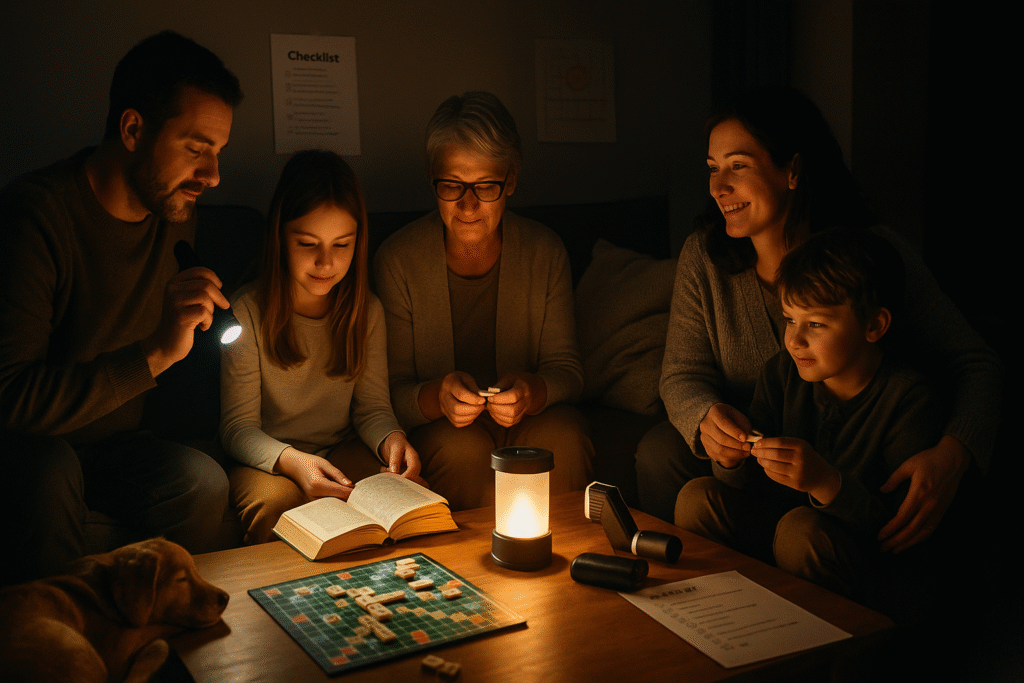
The featured image is an illustrative scene, not a photograph of a documented outage or a product test.
Five practical steps to prepare for a power outage
1. Make a household plan
Start with what your household would need to keep doing without electricity. Write down how you will get outage and emergency updates, where you will meet or check in, and where you could go if your home becomes too hot, cold, or unsafe.
- Save your electric utility’s outage-reporting number and official update page.
- Keep a paper contact list and a check-in contact who lives outside your immediate area.
- List household needs such as powered medical equipment, refrigerated medication, mobility or communication devices, infant supplies, and pet care.
- Choose a safe place you can reach if officials advise leaving or your household cannot safely manage the temperature or medical needs at home.
If someone relies on powered medical equipment or temperature-sensitive medicine, make an individual plan with their health care professional and equipment provider before an outage. Ask your utility what notification or assistance options it offers. Availability and eligibility vary, so do not assume registration guarantees uninterrupted service or priority restoration.
2. Build a several-day supply kit
Ready.gov recommends storing at least one gallon of water per person per day for at least three days, for drinking and sanitation, along with a three-day supply of nonperishable food. Household needs vary. Plan for children, pets, health conditions, hot weather, and any local water advisories.
- Water and ready-to-eat food that does not depend on refrigeration or cooking.
- A manual can opener if you store canned food.
- Prescription medicines and a written list of medicines, doses, and important contacts.
- First aid and sanitation supplies, including hand-cleaning supplies and bags for waste.
- Items for infants, older adults, people with disabilities, and pets, as applicable.
- Cash, copies of key documents, and a small amount of basic household supplies.
Keep supplies together in a place everyone can reach. Review them periodically and replace expired food, medicine, or batteries. See the Ready.gov emergency supply checklist for a broader list.
3. Prepare light, phone charging, and information
Put a flashlight or battery-powered lantern where people can find it in the dark. Store spare batteries that fit your equipment. A battery-powered or hand-crank weather radio can provide another way to receive updates if internet or mobile service is unavailable.
- Charge phones, power banks, and rechargeable lights before severe weather arrives.
- Keep a car charger or other compatible charging option available.
- Write down important phone numbers and the utility’s outage-reporting details.
- Use battery-powered lights as the normal outage option. Keep open flames away from children, pets, bedding, and anything that can burn.
The CDC’s power outage supply checklist also recommends emergency lighting, extra batteries, phone charging options, a weather radio, backup smoke and carbon monoxide alarms, and refrigerator and freezer thermometers.
4. Plan backup power around essential loads
Make a short list of what you need to power and for how long. Check each device’s input rating and instructions. A device’s running demand, startup demand, battery capacity, and conversion losses all affect how long a power source can operate it. Do not assume a portable power station will run a refrigerator or medical device for a specific number of hours without checking the actual equipment and setup.
Use the backup power calculator to make a planning estimate for listed devices. For product comparisons, see our 2027 solar generator guide. These resources help with planning and do not replace an equipment manual or advice from a medical-device provider.
If you rent or live in an apartment, check building rules and safe placement before choosing equipment. Fuel-burning generators must never be used inside an apartment, garage, balcony, or other enclosed or near-home space. See our apartment backup power guide for renter-specific considerations.
5. Practice a simple response
Walk through the plan with everyone in the household. Show them where the lights, radio, supplies, and written contacts are. Explain who checks on children, pets, or anyone who needs assistance. A short practice helps reveal missing batteries, confusing instructions, or supplies stored where no one can reach them.
What to do when the power goes out
- Check whether the outage is limited to your home or affects the area, then use your utility’s official outage channel or local emergency alerts.
- Use battery-powered lights and keep refrigerator and freezer doors closed.
- Conserve phone battery, use your written contact plan, and prioritize charging for essential devices.
- Follow local instructions. If the home is unsafe, or someone cannot safely manage a medical need or extreme indoor temperature, go to the planned safe location if travel is safe.
- When service returns, follow utility and appliance instructions before restoring equipment. Check food temperatures and discard food that is no longer safe.
Food safety during an outage
Keep refrigerator and freezer doors closed. The CDC says food can stay safe for up to four hours in a refrigerator, 48 hours in a full freezer, and 24 hours in a half-full freezer when the doors remain closed. Keep an appliance thermometer in each. The refrigerator should be at or below 40°F, and the freezer at or below 0°F.
If the outage reaches four hours, use a cooler and ice or frozen gel packs for refrigerated perishables when available. Never taste food to decide whether it is safe. Follow the CDC’s food safety guidance after a power outage; when safety is uncertain, throw it out.
Medical needs, heat, and cold
People who depend on electrically powered medical equipment or refrigerated medicine should make a backup and relocation plan with their clinician, equipment provider, and utility before an outage. Confirm what power source the device can use, how it should be connected, how long its batteries last, and whom to call if the backup plan fails. Follow the medicine label and ask a pharmacist or clinician how to handle medicine exposed to heat or loss of refrigeration.
Plan where to go if indoor heat or cold becomes unsafe. Ready.gov advises finding a location with cooling during extreme heat or a heated location during severe cold when it is safe to travel. Do not use a gas oven or stovetop to heat a home. Follow local emergency and utility guidance.
Portable generator and carbon monoxide safety
Portable fuel-burning generators produce carbon monoxide, an odorless gas that can be deadly. The CPSC says to operate them outdoors only, at least 20 feet from the home, with exhaust directed away from the house and other buildings. Never run one in a home, garage, basement, crawlspace, shed, porch, or carport. Opening a door or window does not make indoor use safe. Follow the generator manual, including its instructions for wet weather and electrical shock hazards.
Install working smoke and carbon monoxide alarms on each level and outside separate sleeping areas, with battery backup where appropriate. Test alarms monthly. If a carbon monoxide alarm sounds, get outside immediately and call 911. Read the full CPSC generator and carbon monoxide safety guidance.
Power outage preparation checklist
- Household contact plan and utility outage information saved on paper.
- Several days of water, nonperishable food, medicines, and household-specific supplies.
- Flashlights or battery lanterns, spare batteries, a weather radio, and charged phone power banks.
- Refrigerator and freezer thermometers, plus a cooler and cold packs if available.
- A written plan for medical equipment, refrigerated medication, and safe cooling or heating.
- Working smoke and carbon monoxide alarms, and a generator plan that follows CPSC guidance and the equipment manual.
For a printable storm preparation plan, use the Storm Ready Home checklist. Preparing does not mean buying every device. Start with the needs your household would have to meet, then fill the gaps that matter.